
Lovćen National Park
Lovćen is the mountain that stands directly above the Bay of Kotor, and its national park protects the high ground that separates the coast from the interior. It is a compact park with a strong identity, linked both to the name of the country and to one of its most important historical figures. The road that climbs to its plateau is short, which makes Lovćen one of the most accessible of Montenegro's parks and an easy addition to a coastal itinerary.
The mountain is composed of limestone, the porous rock that shapes much of this part of the Balkans. That geology gives Lovćen its bare, stony character, its sinkholes and caves, and the wide, open views that are its main attraction.
The mountain and the country's name
The name Montenegro is commonly connected to the dark, forested slopes that early travellers saw on this mountain, and Lovćen is often described as the mountain that gave the country its name. Whether or not the story is exactly true, the association is deeply rooted in local identity, and the mountain is treated as a symbol rather than merely a place.
That symbolism gives a visit an added dimension. This is not only a viewpoint but a landmark whose name is part of the nation's story.
The mausoleum at the summit
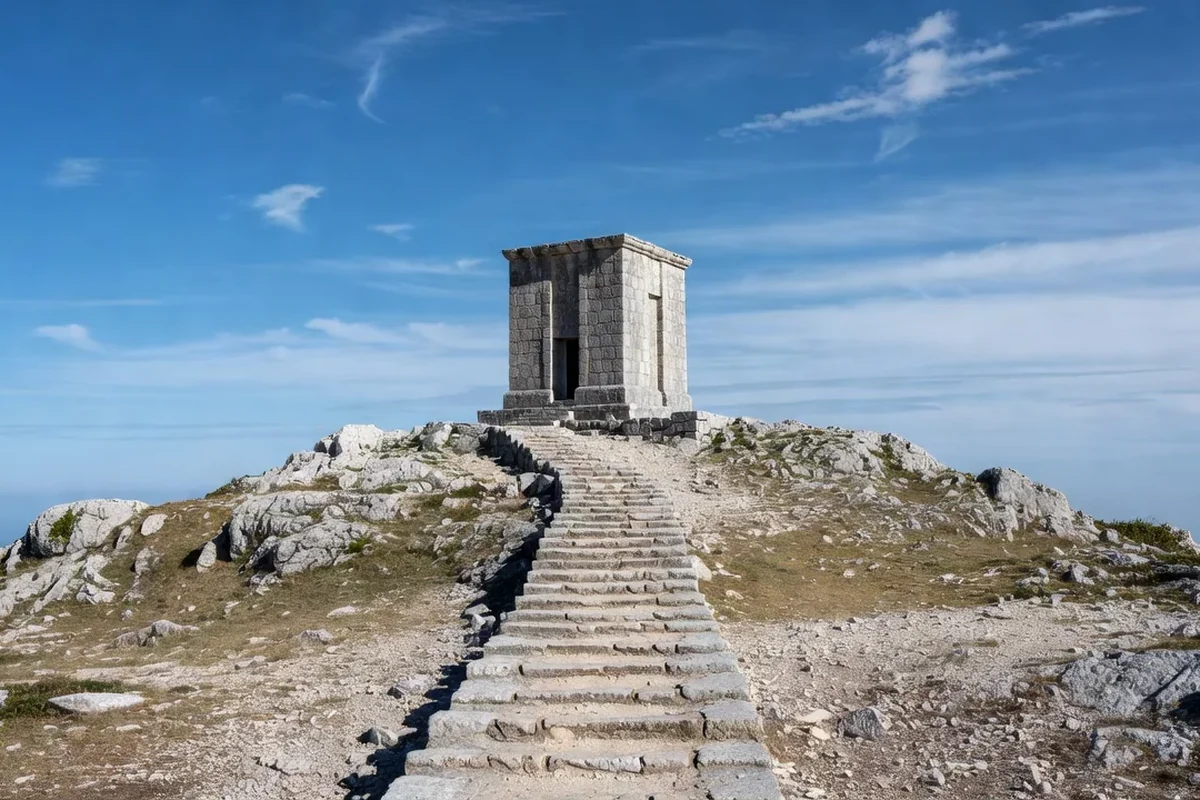
At the highest point of the park stands a stone mausoleum, built to honour Petar II Petrović-Njegoš, the nineteenth-century prince-bishop and poet who is one of Montenegro's central historical figures. The structure sits on the summit, reached from a car park by a tunnel and a long flight of steps, and its design is austere and monumental.
- The mausoleum stands at the highest point of the park.
- Access is by road, then a tunnel and a stairway.
- The setting, not only the building, is part of its effect.
- Weather at the summit can differ sharply from the coast below.
Views over the bay and the interior
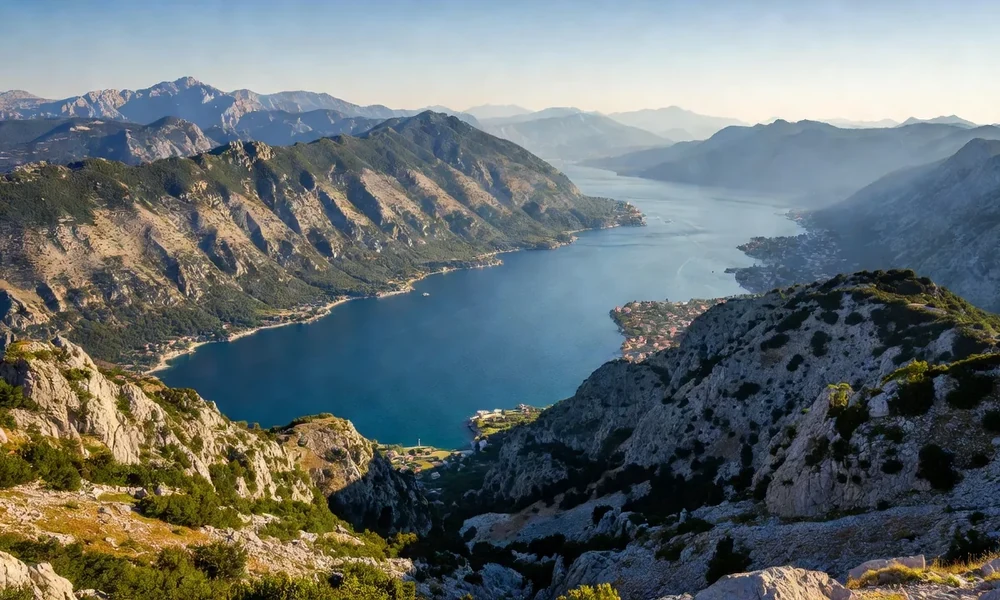
From the plateau and especially from the summit, the view takes in the Bay of Kotor on one side and the interior on the other. That double view is the reason many people climb Lovćen: on a clear day the enclosed bay, the surrounding peaks and the country behind them can be seen at once, and the geography of the coast suddenly makes sense.
The park also offers a network of walking routes across the plateau, past meadows, rock formations and smaller viewpoints. These are quieter than the summit and often more rewarding for anyone who wants to spend a few hours away from the crowds.
A park of many parts
Lovćen's protected area includes more than the summit. It covers high pasture, stony ground and wooded slopes, with villages and traditional stone buildings on its edges. This variety means the park supports both open, exposed landscapes and sheltered, greener valleys, sometimes within a short distance of each other.
The mix is typical of the coastal mountains of Montenegro, where the sea air and the altitude combine to create conditions that change quickly as you move up or down. A walk that begins among trees can end on bare rock within an hour.
Practical notes
The main road climbs from the coast to the plateau, and the drive is winding but manageable. Once at the top, the weather is cooler and often windier than below, so a layer is worth carrying even on a warm day at the seaside. Fog can descend suddenly and obscure the views entirely, which is worth remembering if the summit is the goal.
Facilities on the plateau are limited and seasonal, so it is wise to bring water and food. Entry arrangements and any charges are set by the park authority and should be checked before travelling.
Lovćen at a glance
| Element | Description | What to know |
|---|---|---|
| Location | Above the Bay of Kotor | Short drive from the coast |
| Composition | Limestone plateau | Bare rock and meadows |
| Landmark | Mausoleum at the summit | Reached by tunnel and steps |
| Views | Bay on one side, interior on the other | Best in clear weather |
| Walking | Routes across the plateau | Quieter than the summit |
History on the mountain
Lovćen has been more than a viewpoint for centuries. Its slopes were fought over and its passes were strategic, and the mountain carries traces of that past in its stone buildings, its old paths and its memorials. The mausoleum at the summit is the most famous of these, but the plateau as a whole holds a layer of history that rewards anyone who walks away from the main road.
This history is inseparable from the landscape. The bare limestone, the wooden slopes that gave the country its name and the wide views over the coast all framed the events that made the mountain a symbol, and understanding them is part of understanding Montenegro itself. For a traveller already exploring the Bay of Kotor, the short climb to the plateau adds a historical and emotional dimension that few half-day excursions can match.
Why Lovćen is special
Lovćen packs history, symbol and landscape into a small area. It is the mountain that names the country, the site of a nationally important mausoleum and a place where the whole geography of the coast can be read at a glance. For a visitor based on the Bay of Kotor, it is one of the most rewarding half-days in Montenegro, and one that is easy to reach without any special equipment.
Read next
The Five National Parks of Montenegro
A short tour of the protected areas that together cover the country’s most valued landscapes.
Biogradska Gora National Park
A rainforest remnant, a mountain lake and gentle trails in the Bjelasica range.
Lake Skadar National Park
The largest lake in the Balkans, shared with Albania, and a refuge for water birds.