
Montenegro's UNESCO list: four inscriptions explained
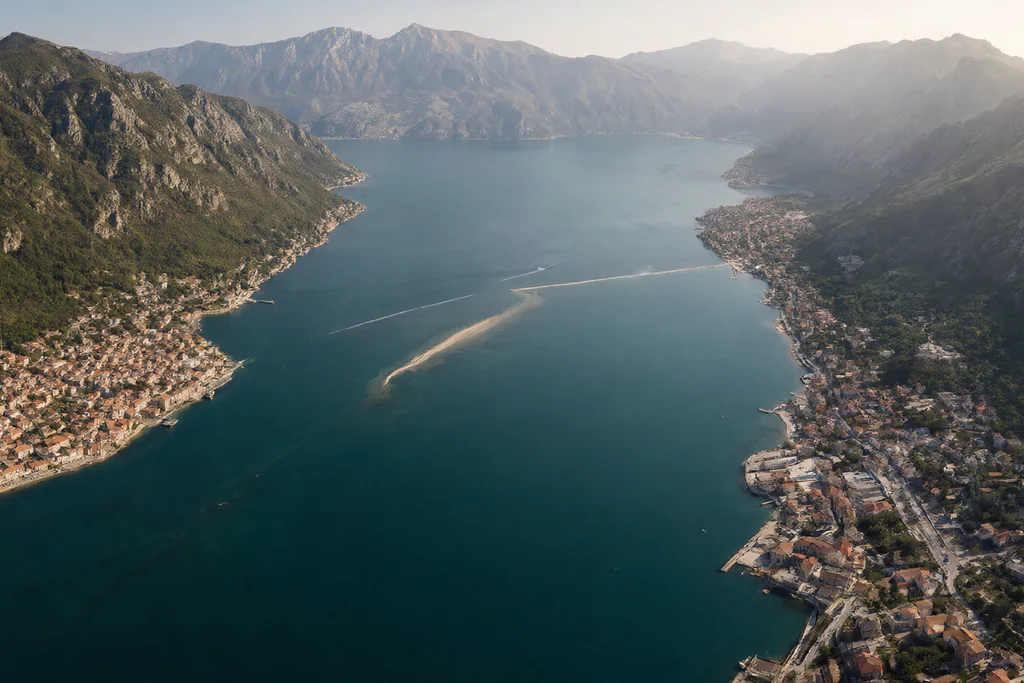
Montenegro has four entries on the UNESCO World Heritage List, and they are not four versions of the same thing. Two are properties nominated by Montenegro alone, one is a serial property shared with three neighbouring countries, and one is a single piece of a defensive system that once ran from the Po plain to the mouth of the Adriatic. Knowing which is which changes what you look at when you arrive.
The list is not a ranking of beauty. It is a register of places that meet criteria set out in the World Heritage Convention, and the wording of each inscription says what the committee judged to be of outstanding value. That wording is worth reading before you travel, because it tells you what to notice.
Four inscriptions, four kinds of property
The four are usually named in the order they were inscribed: the Natural and Culturo-Historical Region of Kotor in 1979, Durmitor National Park in 1980, the medieval tombstones known as stećci in 2016, and the Venetian Works of Defence in 2017. Three are cultural properties and one is natural, and the difference is not cosmetic. A natural listing protects ecosystems and landforms; a cultural listing protects the relationship between people and a place over time.
Kotor: a cultural landscape rather than a monument
The Kotor inscription is often shortened to the name of the town, which is misleading. What was inscribed is a region: the inner bay with its settlements, the steep limestone slopes behind them, and the walls and fortifications that tie the two together. Kotor, Dobrota, Perast and Risan all sit inside the property.
This is why the listing talks about a cultural landscape. The bay is not scenery surrounding a monument; the way the settlements cling to a narrow strip of shore under near-vertical rock is itself the heritage. The property spent time on the List of World Heritage in Danger after the 1979 earthquake and was removed from it once recovery was judged adequate, which is a useful reminder that inscription is a management commitment rather than a prize.
Durmitor: nature listed for its own sake
Durmitor was inscribed a year later, under natural criteria. The property covers the massif itself, the high plateau, the glacial lakes, and the deep cut of the Tara canyon. Its case rests on geology, landforms and habitats rather than on buildings.
- The listing covers the national park, not the whole of the surrounding Durmitor area.
- Glacial lakes, locally called mountain eyes, are part of the reason the massif stands out.
- The Tara canyon is inside the property, which is why river protection and park management cannot be separated.
- Winter snow and summer grazing are both part of the ecology the listing recognises.
The stećci: one tradition, four states
In 2016 the committee inscribed a selection of medieval graveyards as a single serial property shared by Bosnia and Herzegovina, Croatia, Montenegro and Serbia. The stones were carved between the twelfth and sixteenth centuries, many with figures, animals and geometric patterns, and the tradition crosses modern borders because it predates them.
Only a chosen set of graveyards is on the list. Each country manages the sites inside its own territory, and Montenegro's share lies in the high country of the north-west, in the Durmitor and Piva uplands. Visiting them means looking at a field of carved stone in a village or on a slope, not at a museum.
The Venetian works: a defensive chain
The most recent inscription, from 2017, is also the most easily misunderstood. The Venetian Works of Defence between the fifteenth and seventeenth centuries is a serial property with components in Italy, Croatia and Montenegro. Kotor's fortifications are Montenegro's contribution, and they only make sense as part of a system that guarded sea routes and land approaches across a wide area.
For a visitor this is good news, because the walls above Kotor can be read as an engineering argument: terraces, bastions and a long line of ramparts designed for artillery that was still new. The town below is the reason the walls exist, and the walls are the reason the town survived.
What listing changes, and what it does not
Inscription brings an obligation to manage the property to a stated standard, to report on its condition, and to notify the committee of major works that could affect it. In practice it supports conservation planning, monitoring and a degree of international scrutiny. It does not turn a place into a museum, freeze it, or guarantee funding.
| Property | Inscribed | Type | Nomination |
|---|---|---|---|
| Natural and Culturo-Historical Region of Kotor | 1979 | Cultural landscape | Montenegro |
| Durmitor National Park | 1980 | Natural | Montenegro |
| Stećci medieval tombstones | 2016 | Cultural, serial | Four states |
| Venetian Works of Defence | 2017 | Cultural, serial | Three states |
Reading the list before you travel
A listing does not tell you where to park, when a gate opens or what a ticket costs, and those details change from year to year. Check current practical information with the park authorities, the site managers and the official UNESCO documentation rather than relying on a guide written years ago. What the list does give you is the reason a place matters, and that is the part that does not go out of date.
Read next
Kotor in cruise season: planning around the crowds
Time a Kotor visit around the ships: early mornings on the walls, quieter gates, Perast as the alternative, and why the middle of the day belongs indoors.
Durmitor before you hike: what to check first
Trail marking, late snow, entrance fees, water on the karst plateau and afternoon storms: what to confirm before walking in Durmitor National Park.
One week, four UNESCO sites: a Montenegrin route
A seven day Montenegrin route linking Kotor, the Venetian fortifications, Durmitor and the stećci graveyards, with transport notes and booking advice.