
Budva Old Town and the Riviera
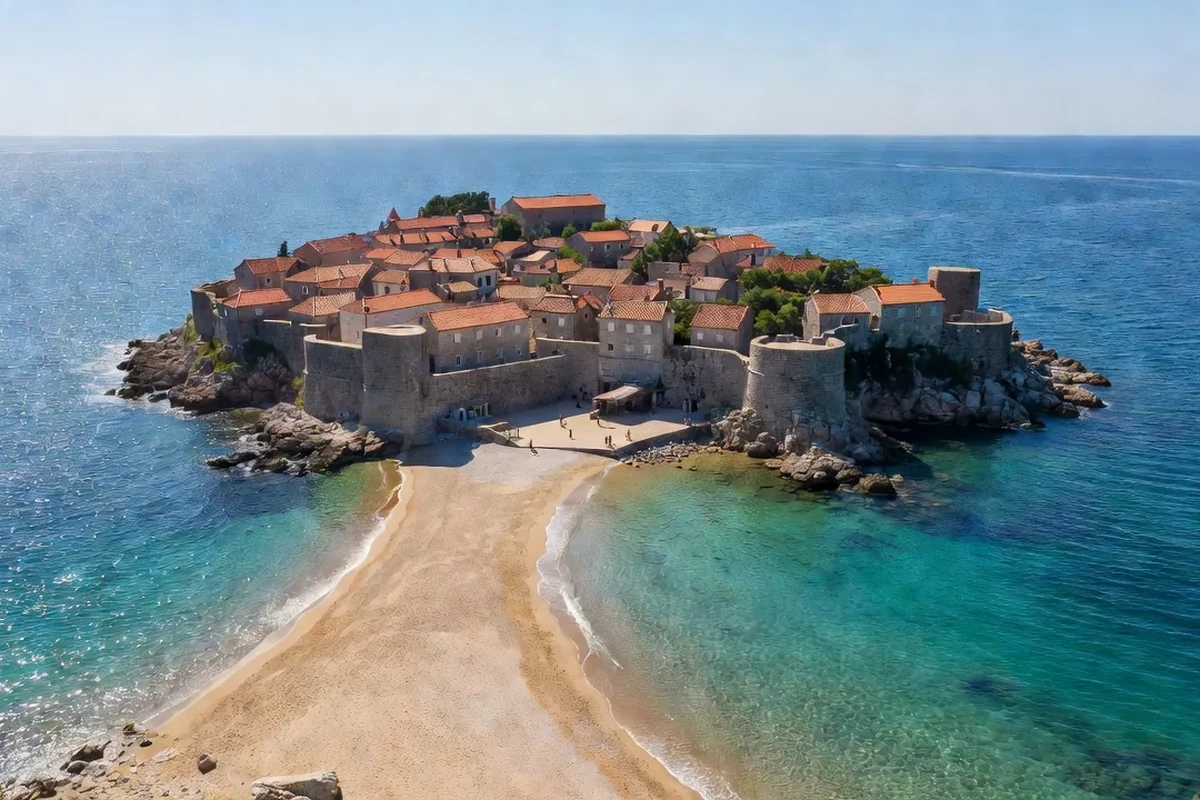
Budva is the best-known resort town on the Montenegrin coast, and its name is used for a long stretch of the Adriatic shore known as the Budva riviera. The town itself sits on a small peninsula, where an old walled settlement survives among the modern hotels and beaches that surround it. This mix of a compact historic core and a busy resort is what gives Budva its particular character.
For a traveller, Budva works on two levels. Inside the walls there is a dense old town of stone lanes, churches and small squares; outside, the riviera offers beaches, promenades and the facilities of a long-established holiday destination. Understanding both sides helps make sense of the place, because they belong together.
The old town on its peninsula
The old town of Budva occupies a small peninsula that juts into the sea, and its walls once enclosed the whole settlement. Inside, the streets are narrow and the buildings close, arranged around a few small squares. Churches, galleries and traditional houses stand side by side, and the gates and stretches of wall that remain show how the town was defended.
Because the peninsula is small, the old town is quick to explore, but it is worth taking slowly. The pleasure is in the details: stone arches, worn steps, small chapels and the sudden views of the sea where the lanes meet the walls.
The riviera coast
The Budva riviera stretches along the coast on either side of the town and includes a series of beaches, coves and settlements. Some are busy and developed, with beach clubs, restaurants and water sports; others are quieter and more natural. The coast here is a mix of sand and pebble, with clear water and a mild climate through much of the year.
- The old town occupies a small peninsula.
- The riviera includes many beaches and coves.
- Some beaches are developed, others are quieter.
- The coast is a mix of sand and pebble.
Beaches and the summer season
Beaches are the main draw in summer, and the season is long, beginning in late spring and lasting into early autumn. At the height of summer the most popular stretches are crowded, and the atmosphere is lively and commercial. Outside the peak weeks the coast is calmer, the water is still warm, and the town itself is easier to enjoy.
Water quality and facilities vary from beach to beach, and some are reached only on foot or by boat. As on any coast, visitors should follow local advice about swimming, currents and sun exposure, and should respect any restrictions in place.
Around the old town
Close to Budva, other places along the riviera deserve attention. Bečići, with its long curving beach, lies just to the south-east, and further along the coast there are smaller resorts and fishing villages. Inland from the shore, the terrain rises toward the mountains of the interior, so it is possible to combine a beach holiday with excursions into the hills.
This combination of sea and mountain is typical of Montenegro, and Budva is a convenient base for it. A morning on the coast can be followed by an afternoon in the hills, without a long journey.
History and setting
Budva is old. Its origins reach back to antiquity, and over the centuries it passed between different powers, which left their mark on its buildings and its name. Earthquakes have damaged the town more than once, and much of what stands today is the result of rebuilding, which is part of why the old town feels both ancient and restored at the same time.
The setting is inseparable from the history. A small peninsula with a safe harbour and fertile land behind it was worth settling, defending and rebuilding, and that is exactly what happened here for a very long time.
Budva in brief
| Element | Description | What to know |
|---|---|---|
| Town | Budva, on a small peninsula | Compact walled old town |
| Riviera | A long stretch of coast | Many beaches and coves |
| Season | Long summer, mild springs and autumns | Crowded at peak times |
| Nearby | Bečići and smaller resorts | Easy to reach from Budva |
| Character | Historic core and modern resort | Sea and mountains together |
Practical notes for a visit
Budva is well connected to the rest of the coast and is easy to reach by road. In summer, parking and traffic are the main practical challenges, and many visitors arrive by bus or on organised trips instead. Accommodation ranges from hotels to private rooms, and the town is lively well into the night during the season.
For a calmer experience, visit in the shoulder seasons, when the weather is still pleasant but the crowds are smaller. Whenever you come, keep to the rules of the beaches and the old town, respect the people who live there, and take care of the coast, which is the reason everyone is here in the first place.
Why Budva is popular
Budva succeeds because it offers two things at once: a genuine old town with centuries of history and a long, accessible coast with everything a summer holiday needs. It is not the quietest or the most remote part of Montenegro, but it is one of the most complete, and for many visitors it is the natural starting point for exploring the Adriatic shore.
Read next
Kotor Old Town
Squares, churches and lanes inside the walled town at the head of the bay.
Herceg Novi
A hillside town of steps and gardens guarding the entrance to the Bay of Kotor.
Perast and Our Lady of the Rocks
A baroque waterfront of captains’ houses and an island church in the bay.